

Pterosaur teeth are always arranged in a single row along the jaw margin where they are present. They are simple, evenly curved and narrowing to the crown, as in many other non-pterosaur species.
B = Buccal (towards the inner mouth or buccal
cavity).
L = Lingual (towards the lips or outside of the
jaw).
A = Anterior (towards the front of the animal).
P = Posterior (towards the rear of the animal).
The orientation of surfaces of teeth are important when dealing with wear and mechanical stress. The tip of the tooth is called the crown and the base of the tooth is called the root. Pterosaur teeth have an open root.
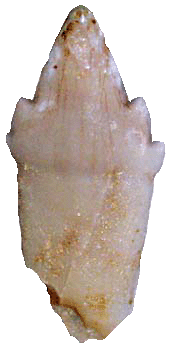
The earliest form of pterosaur tooth is a
flat shearing tooth with 5 cusps. This type of tooth is seen in the
Triassic species, Eudimorphodon. These teeth are extremely rare
and only a few isolated specimens are known. |
|
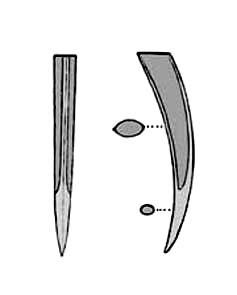 |
These teeth are often found in isolation, but they are still quite rare. To be sure that the tooth is Rhamphorhynchoid, the enamel and dentine need to be preserved in some distinct form of fossilization. On the most prominent teeth, there is usually a wear facet. This will be seen as a smooth flat diagonal area on the buccal or lingual surface of the tooth. The position of the wear facet depends on the association of the opposing teeth during life. To be confident of having such a tooth, it generally needs to be associated with a jaw fragment or other fossil material. |
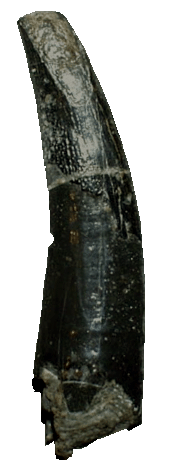
Both of the teeth on the right have wear facets the left tooth has a small wear facet on the crown, the right tooth has a large wear facet extending down from the crown on its anterior buccal surface. Again, to be sure that you have a pterosaur tooth, it will need to be associated with other pterosaur remains. |

 |
Other rare pterosaurs like Pterodaustro and Ctenochasma have very long and thin teeth. It is unlikely that such teeth would survive intact away from a preserved jaw.
It is worth knowing that pterosaur material is rare and can command a good price on the market. Pterosaur teeth are also rare and it is unusual to find large quantities of them. Several other fossil species show similarities with pterosaur teeth, especially some juvenile crocodiles, plesiosaurs and some fish.
There are a lot of fossil teeth coming out of the Moroccan sediments and some 'pterosaur like' teeth were identified as Ornithocheirid some years ago. In 2000 they were being identified as Anhanguerid teeth and by 2002 they were being sold as Siroccopteryx moroccensis teeth. Care is needed when dealing with these teeth as many of them are not Pterosaurian. The few teeth that are from pterosaurs are likely to be from a range of species, some of which are not yet identified.
More identification information
Enquiries about pterosaur teeth are welcome, drawings or photographs would be appreciated. Identification of teeth without examining the actual fossils is not always reliable.