Heliports consist
of a landing pad and an approach zone, similar to any runway.
A helicopter needs a clear approach for 4000 feet from an
altitude of 500 feet within a 500 feet lateral area.
When positioning helipads, this consideration is important.
Helipads need to be on a flat surface with a safety zone
defined around the pad.

This image shows a typical airport style helipad with a clearly marked safety line around the Touchdown and Lift Off area (TLOF). The white line defines the Final Approach and Take Off Area (FATO).

When placing helipads, the surface can create issues. Here, a rooftop helipad has been placed on a sloping surface. The centre point is at ground level. Also a polygon helipad has been placed over an asphalt polygon, near a sloping surface which could cause downwash issues with a helicopter.
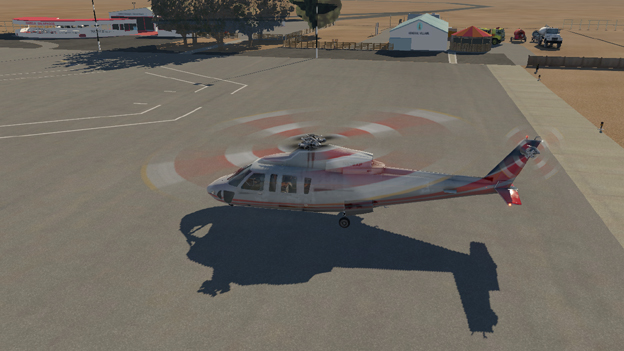
Some airfileds will not have marked helipads, but they may have designated ramp areas where a helecopter can safely land.
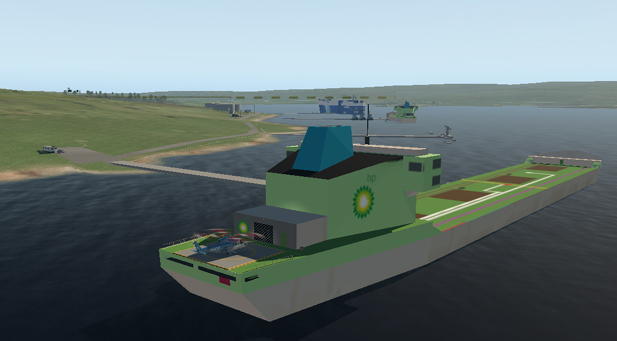
This tanker is moored at Sollum Voe oil terminus in the Shetlands. The helipad on the helicopter deck is a rooftop library helipad set at the deck height above sea level. A second tanker also has a helicopter deck and there is a helipad on shore. This scenery was set up as a training ground for helecopter handling. Night lights are also functional.
Where you have a flat ground area, it is simple to create heliport ground markings. Firstly, create a texture file with the marking pattern you require and save it as MyHelipad.dds. By creating a .dds file, the blank textures will be transparent and allow the background to show.
Create a .pol file using Notepad or a similar plain text editor - as follows
A
850
DRAPED_POLYGON
TEXTURE_NOWRAP MyHelipad.dds
SCALE 25.00 25.00
LAYER_GROUP markings
Save the text file as MyHelipad.pol (or a more suitable name for the scenery model). A helicopter ramp can be added and any additionals lines and lights installed. The scaling on the .pol markup can be adjusted - the NoWrap will only permit one copy of the image to show, whatever the size of the polygon in WED.
https://www.faa.gov/documentLibrary/media/Advisory_Circular/150_5390_2c.pdf