These lights give pilots the angle of descent to the runway touchdown point. They can both be seen at 4 nautical miles in most weathers and have a vertical visible range of 20 degree from the runway touchdown point. VASI (Visual Approach Slope Indicator) is visible for 10 degrees either side of the runway threshold (20 degrees total) and PAPI (Precision Approach Path Indicator) is visible at 15 degrees either side of the runway threshold (30 degrees in total).


When setting the runway lights, you just need to select the option for each runway.

This
system of runway lights defines the basic runway outline and shows a
short static approach line. ALSF-1 has a set of 3 white
strobes
that flash in sequence, moving towards the runway. ALSF-2 has
a
bar of tripple amber lights extending in the line of approach, with a
flashing white strobe, moving towards the runway. Some pilots refer to
these types of strobe light approaches as "chasing the rabbit".

Calverts provide an easy
to see approach line that is marked down to the runway threshold (The
bar of green lights). These lights are constantly on and have no
strobes. The PAPI lights can be seen to the left of the
runway.
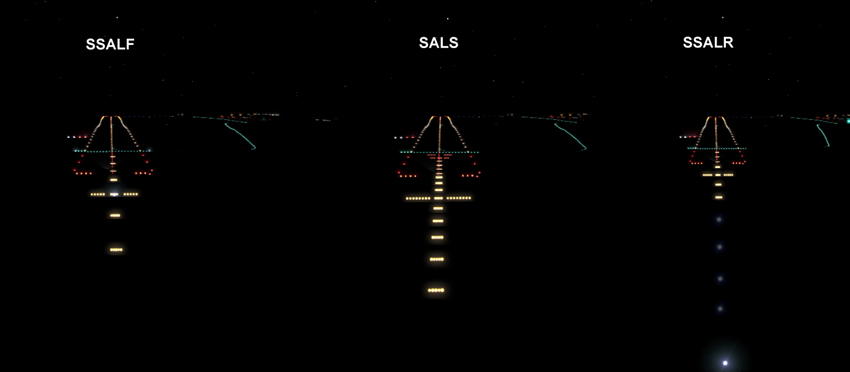
This lighting arrangement is used where space is limited at the end of the runway, SSAL is the Simplified Short Approach Light System. F specifies the Sequenced Flashing System and R specifies the Runway Alignment System.
MALS - Medium Intensity Approach Light System

Lightweight approach light system used for smaller air traffic. MALSR has a strobe Runway Alignment System and MALSF has Sequenced Flashing System lights.
ODALS - Omnidirectional Approach Light System

These approach lights can be seen from all directions, not just by aircraft on the runway approach. The Runway Alignment System (RAS) is a set of 3 strobe lights sequenced towards the runway threshhold. The lights can be seen on both ends of the runway.
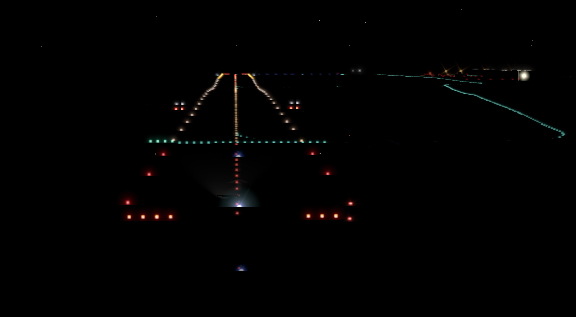
RAIL lights consist of a green light across the runway threshhold and three strobe lights making a Runway Alignment System. In this example you can see a double VASI descent indicator on each side of the runway.
CAA CAP637 Visual Aids Handbook.pdf