The rhamphorhynchoidea generally had thin monocuspid teeth
that curved evenly and reduced in breadth evenly, with a constant cross
section throughout. These teeth were hollow rooted.
|
|
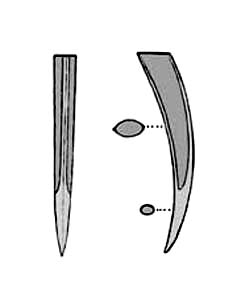
This drawing of a Generalised Rhamphorhynchus tooth shows the degree of the curving and the cross sectional shape. The tooth is very even in its form and shows a consistent section throughout, with a hollow base. There is an enamel cap to the tooth and there is a small strip of enamel running down the front and rear of the tooth.. This tooth form was quite consistent, with a variation in size between species. Some species show a much larger tooth form at the front of the jaw.
|


Dorygnathus banthensis shows a good example of how the size of the teeth reduce towards the back of the jaw. Other forms like Campylognathoides show a more even tooth size throughout.

Scaphognathus with a more even sized tooth distribution.
Wellnhofer P., 1975, Die Rhamphorhynchoidea (Pterosauria) der Oberjura-Plattenkalke Süddeutschlands. Teil I. Allgemeine Skelletmorphologie. Paläontographica A 148 , 1–33.11 plates.