Pterosaur teeth are difficult to identify out of context. Without associated jaw material, the identification of a pterosaur tooth is, at best, a guess. For that reason it is best to seek advice from a pterosaur specialist before pronouncing that a fossil tooth is a pterosaur tooth.
Identification check list - most pterosaur teeth will exhibit these features.
|
|
|
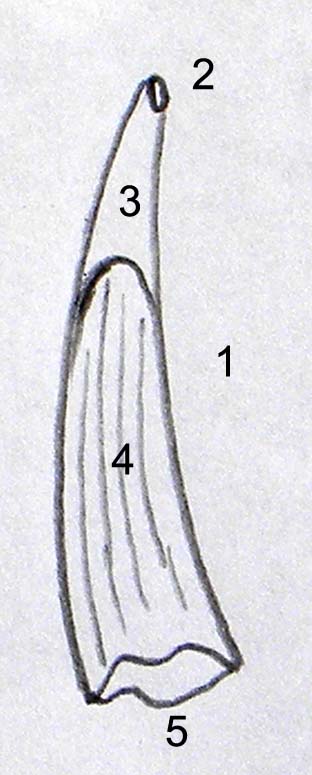
Some larger pterosaur teeth may also show an oval shaped wear patch half way
down the tooth where it has rubbed on the side of the opposing tooth when the
jaw was closed.
If the tooth does not conform to this type, then the only sure way to know that
it is a pterosaur tooth is for it to be fixed within a fragment of fossil jaw
bone where the bone structure can be determined.
Most pterosaur teeth are evenly oval in cross section and generally of smooth
appearance. There are some exceptions, like the tricuspid teeth of the very
early pterosaur species. Specialist feeders like Dsungaripterus and
Pterodaustro, but the shapes of these exceptional teeth are well documented.
Be aware
Pterosaur teeth have a similar shape to the common sabre toothed herring - Enchodus species.
Where a small crocodile tooth has been water worn, it can easily be confused with a pterosaur tooth.
Some plesiosaur teeth where the base has broken
off look surprisingly like pterosaur teeth.
Bowerbank J. S., 1847, Microscopical observations on the structure of the bones of Pterodactylus giganteus and other fossil animals. Q. J. geol. Soc. Lond. Ser. 2, 4, 2–10 and pls 1–2.
Chiappe L. M. and Chinsamy A., 1996, Pterodaustro’s true teeth. Nature 379, 211–212
Chinsamy A. and Kellner A. W. A., 1996, Unravelling the microstructure of pterosaur teeth. Jour. Vert. Paleont., 16 (suppl. to 3): 27-28A
Elias F. A., Bertini R. J. and Medeiros M. A. A., 2007, Pterosaur teeth from the Laje do Coringa, middle Cretaceous, São Luís-Grajaú basin, Maranhão state, Northern-Northeastern Brazil. Revista Brasileira de Geociências. 37(4): 668-676
Fastnacht M., 1997, New light on tooth replacement of pterosaurs. J. Morph. 232, 253.
Fastnacht M., 2008, Tooth replacement pattern of Coloborhynchus robustus (Pterosauria) from the Lower Cretaceous of Brazil. Journal of Morphology, 2008 Mar; 269(3):332-48.
Pursglove P., 2006, Fossil Focus, How to identify a pterosaur tooth, Deposits, 7, Aug 2006
Wellnhofer P. and Khun O., 1978, Handbuch der Paläoherpetologie. Teil 19. Pterosauria. Stuttgart: Verlag Gustav Fischer.